Sometimes
life is more dramatic than even any story we can make up. If somebody were to write a movie script even remotely resembling what has happened in the last year around the
Boston Marathon it would have been consider far flung fiction if not outright
fantasy.
Sometimes
life is more dramatic than even any story we can make up. If somebody were to write a movie script even remotely resembling what has happened in the last year around the
Boston Marathon it would have been consider far flung fiction if not outright
fantasy.
And yet here
I was a year later standing in the runner’s staging area with about 36,000
other runners, preparing to write the final chapter in a story that will
clearly have its own chapter in Boston’s history.
It’s a
fascinating story that includes thousands of victims, tens of thousands of
heroes, two despicable villains and over a million supporting extras. It ends with an American winning the race for
the first time in 31 years and carrying the names of the 4 people who lost
their lives on his chest.
For me the
day started at 4 AM.
There’s
three ways to get into Hopkinton on race day…ride the BAA supplied school buses
out of Boston, get a seat on one of the few private buses that have permission
to enter the runner staging area, or get a ride to one of the parking area
outside the town and that provide
shuttles to the start. If you choose
the BAA school buses you have the privilege of sitting in seats designed for
school children with your knees banging against the seat in front of you for an
hour as the bus (sans shocks) bounces its way out to the start. Once there you are dumped outside in the
runner staging area, a catchy name for practice fields behind the high school,
for your 3+ hour wait. The private buses (usually belonging to big
charities or large runners clubs) offer the luxury of warm comfortable seating
where you can stay until the walk to the starting area and a bathroom.
The good
news…I had been granted a seat on one of the charity buses by a close friend. The bad…because of the new security rules the
roads into the starting area were being shut down early so the private buses
had to leave Boston by 5:30 to make the trip out to Hopkinton.
The
logistics around the race had changed a lot this year because of increased
security. In prior years you were
given and oversized bag with your number on it that you could put your clothes
and personal affects into at the start and then they would be bused to the
finish and be waiting for you when you are done. Having dry clothes, a towel, some aspirin
and maybe your phone to call your family, when you are tired, sweaty and sore
is a pleasure hard to describe. The
increased security this year changed three things: the bag was smaller and
transparent, you had to check your bag
at Boston Common on race morning before heading out to Hopkinton, and you had
to walk to the Boston Common to pick up your bags after the finish (a distance
of at least a half mile. If you didn’t go into the Boston Common in the
morning to leave your bag then you have nothing waiting for you at the
finish. Equally interesting, since it
is pretty cold sitting around waiting for the start (it was in the 30’s when I
got there), everyone brings extra clothes to stay warm. In prior years they would then put them in
the bag to go to the finish. This year
anything you weren’t going to wear in the race got discarded in the staging
area or along the half mile walk down to the start. Runners, frequently with a sense of humor,
had all kinds of responses to the situation.
I rode with a Boston Red Sox fan who was wearing an old NY Yankees
sweatshirt just so he could throw it in the pile of trashed clothes. A heard a similar story who was wearing a
shirt from an old flame. There was a guy
with white cotton sweat pants and sweat shirt that still had a tag on each that
said 2 for $10. For me it was a pair of
sweat pants that had seen better days and a running jacket I had worn at the
start of the marathon 30 years earlier.
I thought it was a fitting burial.
There was literally hundreds of trash bags filled with clothes that were
being collected for one of the local charities.
New this
year was the increased security around the runner staging area. There were hundreds of military, swat teams
and state police surrounding grounds.
All kinds of military toys and surveillance equipment were apparent and
there were sharpshooters on the roof of the school. Every runner was scanned before entering the
runner village and no backpacks or large bags were allowed inside. Despite the increased security and the volume
of runners, once inside the village it was the normal Woodstock-ish pre-race
party atmosphere. But there was also an emotional and sometimes defiant
tone to the runners with many conversations about “not letting any terrorist
scare us off” or “taking back the finish line”. For thousands of runners who had been
stopped short of the finish line last year, this was their chance to finish a
race that had started over a year earlier.
I spoke to many who were stopped with less than a mile to go and one who
was turned back literally a hundred yards away.
“Boston Strong” shirts and tattoos were everywhere. The support from runners from all over the
world was inspiring.
Because of
the number of runners (10,000 more than the normal limit) there were 4
different starting times (or waves) starting at 10 AM and in each wave there
were 9 corrals (holding areas). Your
number determined your wave and corral and these were ordered based on your
qualifying time. I was in Wave 3 going
off at 11AM.
The weather
at the start was perfect, in the low 50’s and a bit overcast. It could have been the enthusiasm of the
crowds, the pent-up emotions, the great weather or all the above that
contributed to a fast early half of the race for me. Big mistake and I should have known
better. By the time I was half way the
sun was out, the temperature had jumped up to 70 and I was cooking like a slice
of bacon on a hot griddle. Despite
taking water and Gatorade early I couldn’t get enough electrolytes into me to
combat what I had lost and I was cramping up badly. It
was a boost seeing all the family members and the grandchildren at mile 16 but
inspiration didn’t last long.
By the time
I hit the uphills at miles 17-21 I was doing a good imitation of a running
hunchback of Notre Dame. Have you ever
had one of those mornings where you had worked hard in the yard the day before
and as you climb out of bed you were so stiff you felt like someone has
shortened all your muscles? Well it’s
not like that. More like someone has
hung you up like a piñata, handed a group kids bats and told them to have at
it. Even my hands had swollen up to
the point I had trouble holding the cups at the water stops.
I think it
was the crowd that helped keep me going.
They were awesome. There’s a
saying I remembered “when the going gets tough, the tough get going”. In the last couple of miles it was more
appropriately “when the going gets tough, the tough get slow”. I had
slowed to a marathon shuffle yet based on the support from the crowd you would have thought I was
winning the race. At times they were so
loud my ears actually hurt. As I came
around the last turn there was a runner down in the road. He was trying to get back up but he couldn’t
get his legs under him. With a little
help from another runner he made it back to his feet and started wobbling
towards the finish. The crowd went
berserk cheering.
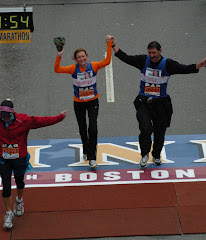
So that was
my day. One of my slowest and most
painful runs but one I will remember fondly given the circumstance of last year
and all the support of friends, family, spectators and other runners. Probably appropriate that 30 years after my
fastest marathon I was back to run my slowest. Will I be back next year? I think so but I need to requalify and we
will have to see what the body (and Pam) says about that.